Case Study
01
Jeddah Landfill Leachate Treatment Plant Rehabilitation
Rehabilitating a Complex 500 m³/day MBR-RO Treatment System
Project Overview
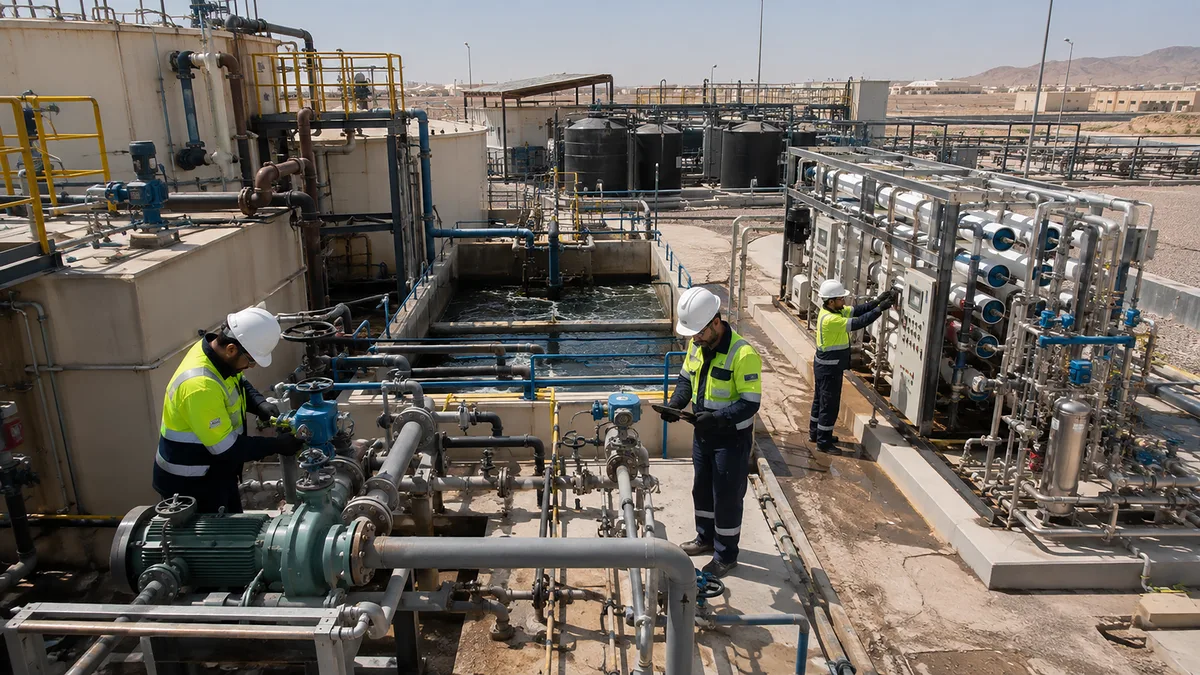
Green Dimension was engaged to assess and rehabilitate a 500 m³/day landfill leachate treatment plant at Wadi Al-Asala in Jeddah. The facility incorporates a complex multi-stage treatment train combining chemical conditioning, clarification, biological treatment, membrane bioreactor technology, filtration and reverse osmosis.
Green Dimension completed a structured condition assessment, identified failures across mechanical, electrical, instrumentation and membrane systems, and executed a sequenced maintenance, repair and rehabilitation program. The work was delivered under successive work orders, with commissioning and operational testing preceding final handover.
Our Strength in Technology
memory
Advanced Technologies
MBR, RO, AOP, EC and customized solutions for difficult waste streams.
engineering
Engineering Excellence
End-to-end engineering from assessment to commissioning.
monitoring
Proven Performance
Delivering measurable results in the most challenging environments.
recycling
Sustainable Outcomes
Focus on resource recovery, reuse and long-term efficiency.
water_drop
500+
m³/day
Plant Capacity
checklist
57
Tasks
Rehabilitation Program
settings_suggest
8+
Systems
Fully Rehabilitated
verified
100%
Operational
Commissioned
The Treatment Challenge
Landfill leachate is one of the most difficult wastewater streams to treat. It is formed as water passes through deposited waste and carries dissolved and suspended contaminants into a concentrated liquid stream. Its composition can vary significantly over time and may include high organic loading, ammonia, suspended solids, dissolved salts, metals and other difficult-to-treat constituents.
At the Wadi Al-Asala landfill in Jeddah, a dedicated 500 m³/day leachate treatment plant had experienced extensive deterioration across its process, mechanical, electrical, instrumentation and membrane systems. A previous technical inspection had identified the facility as largely non-operational, requiring more than routine maintenance or isolated equipment replacement.
Al Yamama Company for Trading and Contracting, acting in connection with the Jeddah Municipality landfill facility, engaged Green Dimension to provide the technical assessment and engineering support required for a structured maintenance, repair and rehabilitation program.
account_tree
Documented Treatment Train
01 Raw leachate lifting and transfer
02 Oil & Floating Removal
03 Chemical Conditioning
04 Coagulation/Flocculation
05 pH Adjustment
06 Lamella Clarification
07 Flow Equalisation
08 Anoxic Biological Treatment
09 Aerobic Biological Treatment
10 MBR Treatment
11 Multimedia Filtration
12 Cartridge Filtration
13 Reverse Osmosis
14 Sludge Handling and Dewatering
15 Chemical Cleaning & Membrane Maintenance
Structured Condition Assessment
Green Dimension began with a stage-by-stage condition assessment covering the complete treatment process. The purpose was not only to identify damaged equipment, but also to understand how failures interacted across the plant.
The assessment reviewed:
- Mechanical equipment
- Pumps and transfer systems
- Chemical dosing systems
- Air blowers and diffuser systems
- Biological treatment equipment
- MBR modules and membrane-scouring systems
- Reverse-osmosis pumps and membranes
- Process instrumentation
- Electrical systems
- Control and automation functions
- Sludge-management systems
- Civil structures and protective coatings
For example, unreliable flow readings can prevent effective dosing control. Inaccurate pH or oxidation-reduction-potential measurements can affect chemical and biological treatment. Inadequate aeration can destabilize the biological process, while membrane fouling or damaged modules can reduce filtration performance and increase the load on the reverse-osmosis stage.
This systems-based assessment allowed Green Dimension to distinguish isolated equipment faults from wider process-control and integration issues.
Restoring the Multi-Barrier Process
The rehabilitation strategy was built around restoring each treatment barrier in the correct sequence. The rehabilitation sequence first restored the preliminary and chemical stages to provide stable feed conditions for biological treatment. Coagulation, flocculation and clarification reduce suspended material and condition the wastewater before biological treatment.
The biological process then addresses biodegradable organic matter and nitrogen compounds through anoxic and aerobic treatment. The available process documentation describes operation with oxidation-reduction-potential control in the anoxic stage and fine-bubble aeration in the aerobic stage.
The restored MBR stage provides biological solids separation and membrane filtration before the treated stream proceeds through multimedia and cartridge filtration. Reverse osmosis then functions as the final advanced polishing barrier.
Restoring the plant required coordinated attention to:

Hydraulic balance
Chemical dosing
Biological stability
Aeration performance
Membrane integrity
Solids management
Instrument reliability
Control-system logic
This sequence reduces the risk of rehabilitating downstream equipment before upstream conditions are capable of supporting stable operation.
Equipment and Technical Supply
Green Dimension’s role extended beyond assessment and planning to include engineered equipment supply, process restoration, site implementation and recommissioning. The project records include successive work orders covering engineered spare parts, MBR and RO components, dosing systems, instrumentation and treatment chemicals used during the rehabilitation program.
Equipment and component selection must account for the aggressive nature of leachate, the process duty, compatibility with existing systems and the operating requirements of the treatment plant.
This integrated scope is particularly important for ageing treatment plants where failures have developed across multiple disciplines.
Current Project Status
Green Dimension delivered the rehabilitation under work orders issued from September 2023, with additional works ordered in November 2024. Commissioning and operational testing precede final handover.
During commissioning and operational testing, the complete treatment system is operated and monitored to verify process stability, equipment performance, control-system functionality and treatment consistency. The results will support final optimization, performance confirmation and formal handover to the client.
Project Significance
This project demonstrates Green Dimension’s ability to diagnose and rehabilitate advanced wastewater-treatment infrastructure rather than simply replace isolated equipment.
The Wadi Al-Asala plant combines physical, chemical, biological and membrane processes within one treatment train. Restoring such a system requires the ability to understand interactions between wastewater characteristics, process chemistry, biological performance, mechanical reliability, membrane condition, instrumentation and control logic.
The engagement also illustrates the strategic value of treatment-plant rehabilitation. Where the underlying process infrastructure remains recoverable, a structured rehabilitation program can restore the value of an existing asset without requiring complete plant replacement.
For landfill operators and municipal authorities, reliable leachate treatment is essential to controlling one of the principal environmental risks associated with final waste disposal. The project therefore sits at the intersection of waste management, industrial wastewater treatment and environmental protection.
Project Highlights
500 m³/day
Landfill leachate treatment plant capacity
Full Train Assessment
Structured assessment of the complete treatment train
57 Tasks
Maintenance, repair and rehabilitation program
Multi-Stage Treatment
Chemical, biological, MBR, filtration and RO stages
Comprehensive Rehab
Mechanical, electrical, instrumentation and membrane
End-to-End Support
From parts supply to commissioning and handover